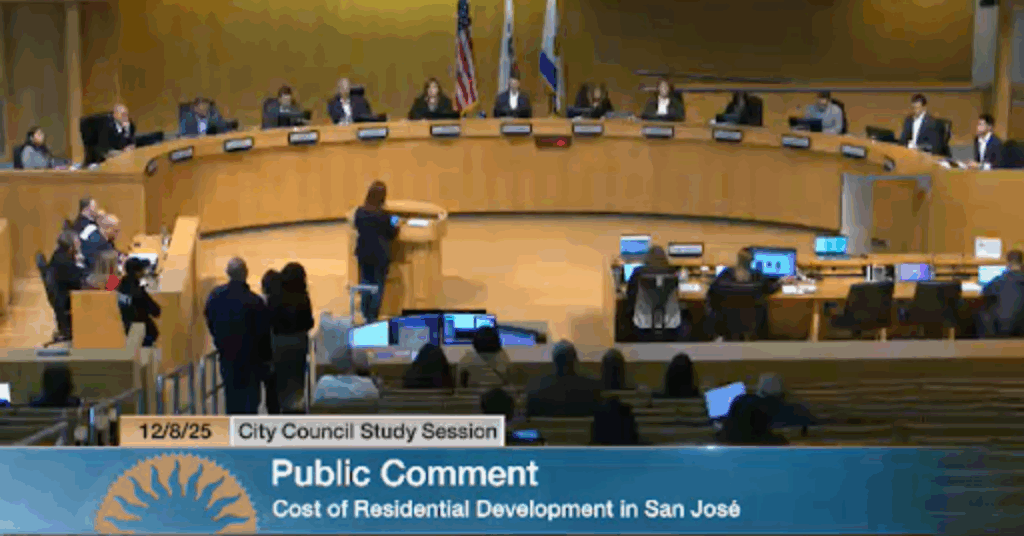
On December 8th, the City of San Jose held a Study Session on the Cost of Residential Development to better understand barriers to housing production, especially barriers the City might be able to eliminate or reduce. Did the Study provide the answers Council needs to make informed decisions?
On December 8th, the City of San Jose held a Study Session on the Cost of Residential Development to better understand barriers to housing production, especially barriers the City might be able to eliminate or reduce, such as City fees. Council does not take any action during study sessions. However, the Study reviewed during the meeting shapes how councilmembers understand the housing development environment in the city and will inform important decisions on housing policy for the next few years.
The Study Shapes Major Decisions
In the coming months, Council will consider the 2026-2027 budget, as well as updates to key policies, including the Inclusionary Housing Ordinance, the Mobilehome Ordinance, the Downtown High-Rise Incentive Program, and tenant utility passthrough in rent-stabilized apartments. All of these are interconnected in impacting housing affordability in San Jose and require a holistic approach that models how changes might interact. We firmly believe decisions on housing affordability should also center the experiences of San José’s residents, especially those most impacted by the housing crisis.
We appreciate the City’s commitment to strengthening San Jose’s housing policies and agree that thoughtful updates can help us move closer to a future where everyone has access to a safe and stable home. To get there, we believe it is essential that policy improvements are grounded in transparent data, robust analysis, and deep engagement with community members and partners across the housing ecosystem. These tools allow all of us to make decisions with clarity, confidence, and shared purpose.
As we reviewed the Cost of Residential Development Study, we saw a valuable starting point—but also an opportunity. The Study could better equip Council to navigate the important decisions ahead with more comprehensive data and analysis that can answer questions relevant to these issues. The decisions Council is called upon to make will shape the daily lives of thousands of San José residents, and our community deserves an approach rooted in a full and clear understanding of what is needed to make housing more affordable and attainable.
The Study is Missing Analysis to Support Decision-Making
Changes to the Inclusionary Housing Ordinance (IHO), which requires developers of market-rate housing to make a proportion of their homes affordable to low-income residents, was originally scheduled for Council consideration on November 18th. Housing Department analysis shows that the current IHO has delivered an average of nearly 300 homes each year affordable to households with incomes at or below the county’s median since its 2019 inception. Forty three percent are affordable to households with incomes at or below 50% of the county’s median. Proposed changes would reduce affordability, shifting the IHO to serve wealthier residents. The Study is not able to answer critical questions about whether it is necessary to change the affordability of IHO homes, and if so, what those changes should be.
We appreciate that the Rules & Open Government Committee, which sets Council agendas, unanimously voted to delay consideration of proposed changes to the IHO until after the December 8th study session, recognizing the need for more data, thorough analysis, and deep engagement to support their decisionmaking. Because proposed IHO changes are tied to development feasibility, it is crucial that feasibility for the affordable homes produced under the IHO, across income levels, are analyzed in a transparent and complete way. Without that analysis, we risk making changes without knowing if they will achieve our shared goals or unintentionally limit affordability. However, the only part of the IHO analyzed in the Study is the in-lieu fee, an alternative form of compliance with the IHO that few developers choose, preferring to build the required affordable homes instead.
The Bigger Picture: Changes to Housing Affordability in San Jose
Many decisions that affect housing affordability are scheduled to come before Council between now and mid-2026. These changes will be compounded by the recent enormous cuts to federal housing, health, and food assistance which create even more pressure on San Jose’s low-income families and individuals. It is critical that the robust stakeholder engagement and deep analysis the Housing Department is known for is leveraged to inform Council decisionmaking. Without it, we will not fully understand the cumulative impact of policy changes until it is too late.
We are committed to working alongside City staff and Council, together with our community partners and residents, to build a stronger, more equitable San José. We believe deeply in what is possible when we engage meaningfully, share information openly, and lead with a vision of housing justice and stability for all. We look forward to collaborating to advance solutions that move us closer to the vision of San José we all share, where everyone has the opportunity to thrive.