Click below for specifics on each housing policy at play on January 27th.
On January 27th, dubbed “Housing Day,” San Jose’s Council will consider significant changes to existing laws and programs that support housing development and affordability. A wide range of items are coming before Council, reflecting different policy goals and tradeoffs. We support several of these proposals, have concerns about others, and see important nuances across many of them that merit careful, issue-by-issue consideration rather than a one-size-fits-all approach.
Many of the changes under consideration would reduce affordability requirements in an effort to spur market-rate development. Three separate items would reduce inclusionary obligations, which require developers of market rate housing to include a percentage of homes affordable to low income households.
The decisions that Council are making this Tuesday will shape the daily lives of thousands of San José residents. Our community deserves an approach grounded in a full and clear understanding of what it will take to make housing more affordable and attainable. As the City considers proposed updates to the Inclusionary Housing Ordinance, the Multifamily Housing Incentive Program, and the Downtown Residential Incentive Program, we believe the process matters as much as the outcomes. A process rooted in transparent, data-supported analysis and meaningful stakeholder engagement—before changes are finalized—will help ensure these policies advance our shared goal of making San José a place where housing is affordable for the many people who call it home.
SV@Home staff have been hard at work, along with many coalition partners, reaching out to housing developers and housing advocates, communicating with City departments, and meeting with San Jose’s Councilmembers and their staff to try to achieve the best possible outcomes from Housing Day deliberations.
Given the scope and implications of these changes and the impact on the lives of the people who live in San Jose, we call on the City to support proposed changes with robust data and analysis, including assessment of the impact on housing affordability in San Jose and the City’s Housing Element obligations, and the insights of all impacted stakeholder groups. If Council elects to approve changes, we urge Council to direct staff to closely monitor outcomes of changes and report back to Council within one year to recalibrate approaches.
Below are the housing policies at play. Click each item to learn more:
- Staff Seeks Council Direction to implement Senate Bill 79: Upzoning Near Transit (would shift capacity for homes away from land set aside for business/employment uses)
- Expansion of the Downtown Residential Incentive Program (would eliminate inclusionary requirement for certain new housing developments and office-to-residential conversions in Downtown, a change not mentioned in any previous community meeting)
- Expansion of the Multifamily Housing Incentive Program (would reduce inclusionary affordability requirement to 5% at 110% AMI, reduce construction taxes for qualifying developments in growth areas)
- Proposal for modified affordability in the Inclusionary Housing Ordinance (would shift rent requirements on market-rate development for inclusionary units upwards, shorten the time these homes stay affordable, and streamline compliance process)
- Soft Story Retrofit Pilot Finance Program (would shift $1.6 million in City funds to finance seismic retrofits in up to 20 vulnerable residential buildings)
- Changes to Mobilehome Rent Ordinance (would allow 10% increase in space rent upon sale of mobilehome, align ordinance with recent changes in state law, create a rent registry, and more) NOT TO BE HEARD BEFORE 6PM
Note that these are listed in order of their appearance on the City Council Agenda.
We recognize the City’s intent to act quickly and move intentionally to create more housing in San José, and we share that urgency. At the same time, we are asking for clear data and analysis to ensure these changes do not unintentionally harm lower-income residents and that they meaningfully address the housing affordability challenges our city continues to face. All of these items are interconnected in impacting housing affordability in San José and require a holistic approach that models how changes might interact. We firmly believe decisions on housing affordability should also center the experiences of San José’s residents, especially those most impacted by the housing crisis.
We appreciate the City’s commitment to strengthening San José’s housing policies and agree that thoughtful updates can help us move closer to a future where everyone has access to a safe and stable home. To get there, we believe it is essential that policy improvements are grounded in transparent data, robust analysis, and deep engagement with community members and partners across the housing ecosystem. These tools allow all of us to make decisions with clarity, confidence, and shared purpose.
The December 2025 Cost of Residential Development Study is a valuable starting point, with room to be strengthened by additional data and analysis that speak directly to the decisions before Council.
NOTE: A Comprehensive Revision to the Policy for Multifamily Revenue Bonds, originally scheduled for consideration on January 27, has been tentatively rescheduled to February 24. These revisions respond to concerns raised by local affordable housing developers, and we support the proposed changes.
The updates would reduce the cost of building affordable housing by allowing developers to use any qualified agency as an issuer for tax-exempt financing through private activity bonds. Currently, City policy requires these bonds to be issued by the City; however, agencies with specialized expertise in affordable housing finance—and the scale to operate efficiently—can often complete these transactions more quickly and at lower cost, helping projects move forward faster.
SB-79: Agenda Item 8.1
Staff Seeks Council Direction to implement Senate Bill 79- Upzoning Near Transit
Exciting news! San Jose is planning for many more homes near transit stations, as City staff prepare to implement 2025’s Senate Bill 79 (Wiener), and balance the need for both homes and employment hubs.
California’s Senate Bill 79 (Wiener), the Abundant and Affordable Homes Near Transit Act, requires cities to allow denser, multi-story housing developments near major public transit stops. Projects will need to meet requirements including density, height, unit size, and labor standards to be eligible for SB 79 benefits. The bill dramatically expands where housing is allowed and the densities at which housing can be built.
This is important because transit-oriented development (TOD) provides homes for people closer to where they work and alternatives to travel by car, reducing traffic and greenhouse gas emissions. SB 79 will also help San Jose prepare for the next housing element by expanding the city’s capacity for residential development now.
The City is also conducting its General Plan Four-Year Review, which is focused on identifying new residential capacity to use in the next housing element cycle and identifying opportunities for missing-middle housing on lower density housing sites. SB 79 will support this work, as well as the streamlining of Urban Village planning for the 25 urban villages within SB 79’s TOD zones.
Staff in the Planning, Building, and Code Enforcement Department will be providing important background information to Council and seeking direction on implementation options.
Local governments can develop their own “TOD alternative plan,” as long as it is approved by the state and delivers at least the same overall increase in housing capacity as SB 79’s standards. The staff memo recommends Council direction to develop an alternative plan to exempt areas designated for job-producing uses, which drive economic activity and City revenues. The memo also lays out several ways in which the provisions of SB 79 can be either delayed or exempted based on detailed criteria. Because the law takes effect on July 1, 2026, the City will need to submit its alternative plan to the California Department of Housing and Community Development (HCD) for review by March.
What SV@Home recommends:
- Support: Direct staff to return to Council in March 2026 with a draft ordinance exempting nonresidential sites within qualifying industrial areas identified in the General Plan as Employment Areas from the provisions of Senate Bill 79.
- Oppose: Direct staff to return to Council with an ordinance temporarily exempting designated historic resources from SB 79, since exemption could only last several years and these sites are subject to the California Environmental Quality Act (CEQA), which offers significant protections for historic resources.
Implementing SB 79 in San Jose
SB 79 applies to counties with more than 15 passenger rail stations, and in the Bay Area this includes Santa Clara, Alameda, San Mateo, and San Francisco counties. SB 79 does not apply to unincorporated areas until the next housing element cycle begins in 2031. In general, SB 79 supersedes local zoning and allows housing on all sites currently zoned for residential, mixed-use, or commercial development within ½-mile of certain transit stops and specifies maximum heights and densities that a local jurisdiction may not restrict.
There are 56 transit stations and approximately 40,000 parcels in San José that fall under the provisions of SB 79. This includes parcels located within a half-mile of a station located in another city; some parcels in San Jose fall within a half mile of the Milpitas BART Station, Santa Clara Caltrain station. Although SB 79 requires the Metropolitan Transit Commission (MTC) to create the official map of TOD stops and their associated zones, City staff has created a draft map based on analysis of the bill to guide work while MTC’s map is under development.
Check out the very informative staff memo to learn about:
- TOD Project Eligibility and Development Standards
- Affordability and Tenant Protections
- Demolition and Anti-Displacement protections
- Approval Pathway and Environmental Review
- The Role of VTA
- And more
Downtown Residential Incentive Program: Agenda Item 8.2
This proposal expands an existing program by making office-to-residential conversions, along with new construction, eligible for incentives to spur additional development in Downtown. The proposal also increases both the number of eligible units and the program’s duration. However, a last-minute change removed even the small 5% inclusionary requirement, affordable at 110% of area median income.
Beginning in 2007, the City Council implemented a Downtown Residential High-Rise Incentive Program to create the opportunity for more residential construction in the Downtown Core. High rise development has moved forward slowly, with the costs of construction, lender requirements, and risks of development making it a challenge for developers to build. The City’s existing Downtown Highrise Program reduces certain fees and the inclusionary housing obligation in recognition of the more expensive building materials and methods required to build higher than 10 stories, the preferred residential development type in Downtown San Jose. Lower costs help podium and wrap-type developments move closer to feasibility, although the recent Cost of Residential Development Study indicates that high rise developments remain infeasible at present despite incentives.
The Cost of Residential Development Study also shows that office-to-residential conversion projects are not currently financially feasible, and that tax and fee waivers may help some conversion projects achieve feasibility. Only a few office buildings in Downtown San Jose, such as the Bank of Italy building, are suitable for conversion to residential uses. These are primarily older buildings with narrow floor plates and functional windows. Conversions of these older buildings carry substantial risk, since it is often difficult to evaluate structural integrity, need for asbestos remediation, and other issues until construction has begun. The elimination of the Inclusionary Housing In-Lieu Fee and inclusionary units are likely necessary to complete this limited number of conversions.
What SV@Home recommends:
- Support the expansion of the Downtown Incentive Program to include office-to-residential conversion, with 0% inclusionary requirement only for conversion, to account for uncertainty and risk.
- Oppose the elimination of the 5% inclusionary housing requirement for new construction, as it would reduce affordable housing production and weaken protections for extremely low-income households. This proposal was not disclosed during public engagement, undermining transparency and highlighting the need for a more accountable and inclusive policymaking process in San José.
Multifamily Housing Incentive Program: Agenda Item 8.3
Expansion of the Multifamily Housing Incentive Program to include more developments over more time
The Multifamily Housing Incentive Program (MHIP) is a time-limited program that attempts to help qualifying multifamily housing developments achieve feasibility by offering deeply reduced construction taxes and inclusionary housing requirements. The 2025 Cost of Residential Development Study identified several types of relatively dense construction that are currently infeasible but close to feasibility.
The program targets qualifying developments with 50 or more units per acre that have received entitlements but are unable to move forward due to financial challenges. Developments must be located in the city’s designated growth areas. Since the MHIP began in 2024, more than 1,400 units of housing have used the program to begin construction.
The proposal would expand the Phase I of the program by doubling to 3,600 the number of units eligible for the deepest incentives—50% construction tax reductions and reduced inclusionary requirements of only 5% of units affordable at 110% AMI, with no in-lieu fees—and extending the building permit deadline to February 28, 2027.
Beginning in March 2027, Phase II would offer the reduced inclusionary requirements of only 5% of units affordable at 110% AMI and a 25% reduction of construction taxes for additional units in eligible projects under the temporary MHIP
Total participation in the program would be limited to 3,600 housing units, including the previously approved allocation of 1,800 units.
What SV@Home recommends:
- Support expansion of the Multifamily Housing Incentive Program as a time-limited and unit-limited temporary means of addressing the uniquely high costs and economic risk of this moment, protecting the underlying Inclusionary Housing Ordinance (IHO).
Inclusionary Housing Ordinance: Agenda Item 8.4
The Inclusionary Housing Ordinance (IHO) requires developers of market-rate housing to make a proportion of their homes affordable to low-income residents. The proposed amendment would shift the affordability levels of these units upwards to serving households with higher incomes.
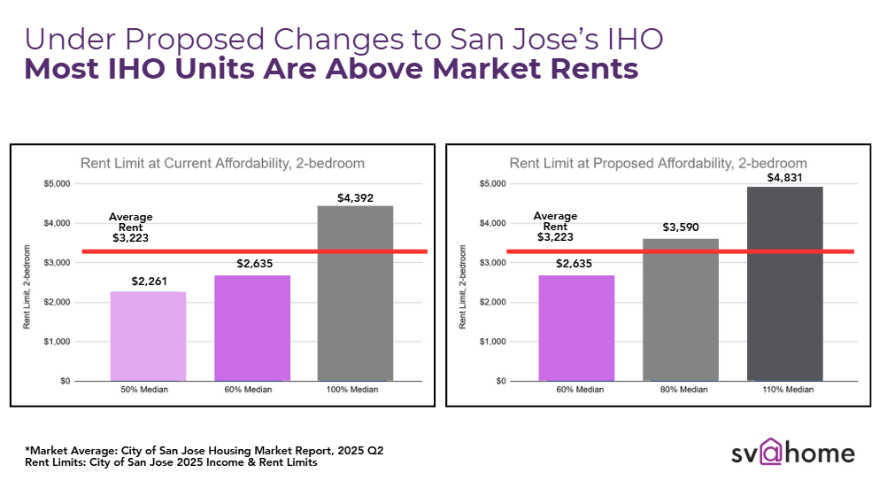
Currently, the IHO offers two options for on-site compliance: (1) building 5% of units affordable to households at 50% of the area median income (AMI), 5% of units at 60% AMI, and 5% of units at 100% AMI, or (2) building 10% of units on site at 30% AMI. The proposed changes would push 2/3 of San Jose’s inclusionary units above average market rents, significantly weakening a tool for affordability at a time when a high and rising cost of living is creating intense pressure on San Jose’s low income families.
Proposed IHO changes and what SV@Home recommends:
- Support: Streamline processing of 100% affordable developments by shifting them out of the IHO approval process to an abbreviated City deed-restricted covenant.
- Support: Enhance an existing surplus credit exchange, which allows developments that exceed the number of inclusionary units required to receive credit toward other projects to meet their IHO compliance. Staff is proposing to clarify eligibility and credit valuation, and add a new city-facilitated exchange system between developers to buy and sell surplus credits.
- Oppose: Revise levels of affordability upward to 5% of units at 60% AMI, 5% at 80% of AMI, and 5% at 110% AMI. (San Jose’s average market rents are affordable to households at about 70% of AMI.)
- Oppose: Remove the compliance option for 10% of units on site at 30% AMI. Multiple compliance options provide flexibility to developers to meet the unique needs of each project.
- Oppose: Shorten the length of time inclusionary units remain affordable from 99 years to 55 years.
- Add: Direct staff to return to Council with an Informational Memo on Alternative Funding Options for Promoting Affordable Housing Development, directed during the 2025 budget process, by Tuesday, March 3 2026. The memo should include an assessment of the number of units and the depth of affordability alternative sources can support, and how this affects the City’s progress toward RHNA and Housing Element programs.
- Add: For any changes made to levels of affordability, direct staff to closely monitor and analyze outcomes of changes and the state of housing affordability in San Jose, and report back to Council within one year and annually thereafter to incorporate insights from analysis and recalibrate approaches.
Why does SV@Home oppose changes to affordability in the IHO without robust analysis and meaningful stakeholder engagement?
Current efforts to amend the IHO suffer from significant process & policy issues.
- No evidence has been provided to demonstrate that proposed AMI changes will facilitate production of market rate housing. While the Cost of Residential Development Study would have been an ideal vehicle to analyze the impacts of IHO requirements at various levels of affordability and model outcomes from several combinations, providing alternatives for Council deliberation, the Study analyzed only IHO in-lieu fees. Because the scope of the Study was narrow, it is not able to answer critical questions about whether it is necessary to change the affordability of IHO homes, and if so, what those changes should be.
- The IHO is an important source of affordable homes for San Jose. Housing Department analysis shows that, since the current IHO took effect in 2019, it has delivered an average of 288 homes each year without City subsidy, affordable to households with incomes at or below the county’s median. About 43% of these homes are affordable to households earning at or below 50% of area median income. This roughly doubles the City’s share of affordable housing development; the City directly subsidizes an average of about 300 affordable homes annually.
- The City has not developed an alternative comprehensive plan to address housing affordability in San Jose. California Government Code Section 65583(c) requires local jurisdictions to “make adequate provision for the housing needs of all economic segments of the community” and “assist in the development of adequate housing to meet the needs of extremely low, very low, low-, and moderate-income households.” The Regional Housing Need Allocation (RHNA) reflects this, with the City of San Jose responsible for 15,088 new very low and extremely low income homes, and another 8,687 new low income homes.
The Inclusionary Housing Requirement is one of few remaining policy tools to create affordable homes. San Jose’s City Council has reallocated nearly all Measure E funds away from affordable housing production. Nearly all funds from Santa Clara County’s 2016 Measure A Affordable Housing Bond, which has supported the development of more than 3,000 homes in San Jose1, have been successfully deployed. Other sources of City funding continue to be diverted for purposes other than affordable housing development (e.g. Low and Moderate Income Housing Asset Funds diverted to fund Soft Story Seismic Retrofit Pilot Financing program). The proposed amendments have not been analyzed for their impact on IHO in-lieu fee revenues, which are a key source of funding for deeply affordable housing.
During the 2025 budget process, Council directed staff to produce an Informational Memo on Alternative Funding Options for Promoting Affordable Housing Development, since Measure E funds were reallocated away from affordable housing. The memo has not yet been published.
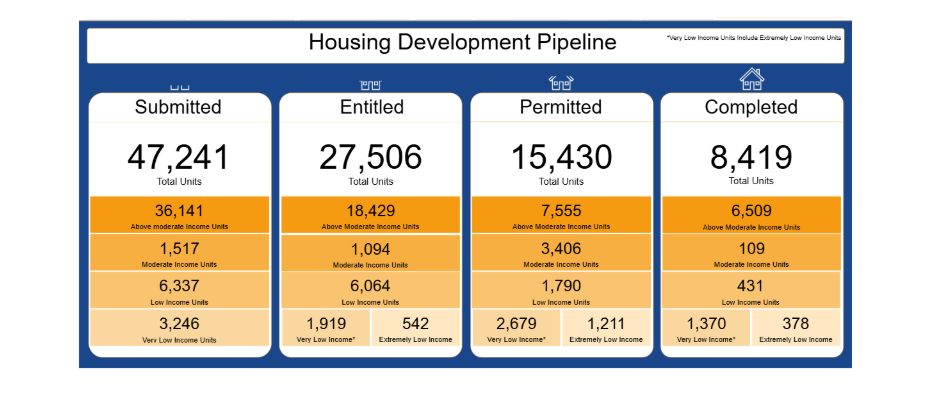
- San Jose’s housing production trends demonstrate market preference for above-moderate income housing. According to data from the California Department of Housing and Community Development (HCD), since 2018, the majority of housing units entitled, permitted, and completed in San Jose have been either above moderate or moderate income. This points to the need to take concrete steps to encourage and support affordable housing development.
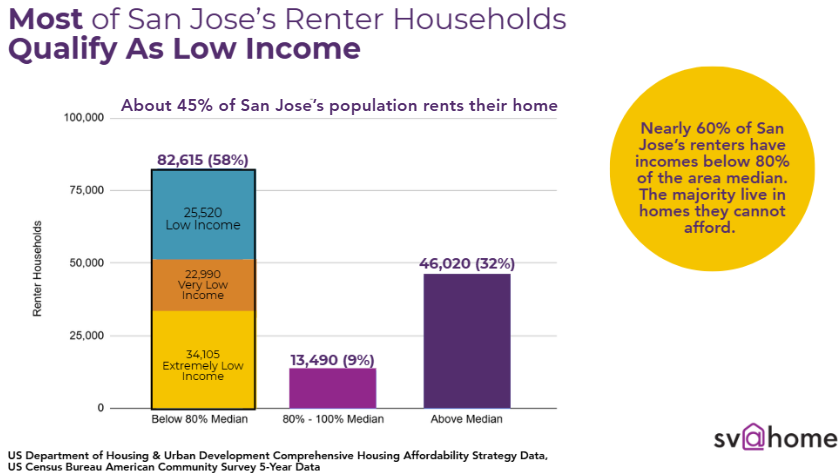
- The housing needs of San Jose’s middle-income renters are addressed by the market. According to the U.S. Department of Housing and Urban Development (HUD)’s Comprehensive Housing Affordability Strategy (CHAS) data,2 nearly 60% of San Jose’s renter households have incomes that fall below 80% of AMI. Less than 10% of San Jose’s renter households fall between 80 and 100% of AMI. Average rents in San Jose for studio, one-bedroom, and two-bedroom apartments are affordable to households earning about 70% of AMI.3,4 This demonstrates that a middle income strategy to meet the housing needs of San Jose’s renter households is less urgent, as they are currently addressed by the market.
- San Jose’s lowest income residents are disproportionately cost burdened because of the City’s shortfall of homes affordable to them. Almost 75% of extremely low-income residents are paying more than half their income for housing costs each month. Only 10% have a home they can afford. While housing affordability affects residents at all income levels, about 75% of moderate-income households have a home they can afford, and are able to compete on the rental market with no cost burden at all.
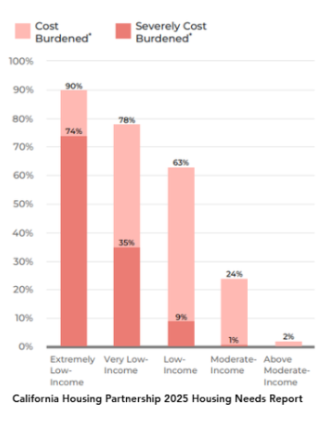
- Deep stakeholder engagement is absent from proposed amendments. The existing IHO reflects a collaborative process that included extensive engagement with the development community to ensure feasible compliance options, as well as robust participation from stakeholders representing the 44% of San José households that qualify as low-income.
In contrast, the proposed amendments to the IHO seem to have been directed entirely by the 2025 March Budget Message, absent data, analysis, or deliberation at that time, and are not responsive to the concerns of the development community more broadly. Multiple community-based partner organizations have indicated that, on outreach to developers including those with large projects in San Jose, none were engaged before IHO amendments were proposed. Likewise, neither the business community nor community-based organizations serving San Jose’s low-income households were engaged before IHO amendments were proposed. While members of the development community and other stakeholder communities were invited to attend presentations on proposed changes to the IHO, their feedback was not incorporated.
- Published materials lack supportive data, analysis, or alternatives for Council deliberation. Council deliberation on the 2019 IHO amendments were supported and informed by a comprehensive 145-page memo that clearly explained the policy’s goals, rationale for staff’s recommended changes and four policy alternatives, supporting analysis for the recommendation and alternatives, and a clearly defined and articulated analytical framework. Since the proposed amendments to the IHO seem to have been directed entirely by the 2025 March Budget Message, with unclear rationale and no analysis, little analysis accompanies the staff memo. The budget process and the Council decisions it requires are complex and difficult, and dividing Council attention between the Budget and policy considerations does not allow adequate consideration of either.
SV@Home, the development community, and partner organizations remain ready to partner with the City to address issues of affordability thoughtfully and comprehensively.
Soft Story Pilot Program: Agenda Item 8.5
Soft-story buildings are especially vulnerable during earthquakes because their ground floors are not strong enough to support upper levels during lateral shaking, leading to structural collapse. San José estimates it has between 2,600 and 3,600 soft story buildings, with between 18,000 and 25,000 homes. Retrofitting these buildings is critical to protect lives and preserve an important source of more affordable housing, home to some of the city’s most vulnerable residents.
The city’s Soft Story Retrofit Ordinance was approved in September 2024 and delayed by uncertainty around federal grants that would help fund a Retrofit Financing Program. It is now scheduled to take effect on April 1, 2026. The financing program is intended to reduce retrofit costs for property owners and limit rent increases for tenants by offering rebates and low-cost financing.
Due to ongoing federal funding changes and uncertainty, Council is now considering a proposal to use about $1.6 million from the City’s Low and Moderate Income Housing Asset Fund for a small, voluntary pilot Soft Story Seismic Retrofit Financing Program. The pilot will be designed to test and validate the operational framework for the future, full scale retrofit program, intended to offer participating property owners a low-cost retrofit finance option while avoiding tenant rent increases.
The pilot will begin in April 2026, will target buildings with 20 units or less who voluntarily join the program on a first-come first-serve basis. Participants will have the option to utilize funding from the program to make additional unit upgrades such as energy efficiency or electrification.
What SV@Home recommends:
- Support the proposed reallocation of funds from the Low and Moderate Income Housing Asset Fund to implement a small scale, voluntary Soft Story Seismic Retrofit Pilot Financing Program.
Mobilehome Rent Ordinance: Agenda Item 8.6
Mobilehomes are an important source of naturally affordable housing, where mobilehome park residents often own their home and rent the land beneath it from the park operator. Mobilehome residents may carry mortgages, pay taxes, fund repairs, and absorb all maintenance costs for their homes. Mobilehome owners are uniquely vulnerable to displacement if there are large increases in space rent because of their limited ability to relocate. Space rent spikes also decrease the value of the home, because they make it less attractive to future buyers. As a result, mobilehome owners can lose a significant portion of their home equity when they are displaced as a result of a space rent increase.
For these reasons, changes to the Mobilehome Rent Ordinance have direct implications in the region’s affordable housing system, particularly for extremely low-income households. Maintaining strong protections is necessary to preserve existing affordable homes, protect residents from displacement, and ensure that efforts to produce new housing do not come at the expense of the most affordable housing already in the community.
The City’s first Mobilehome Rent Ordinance (MRO) was adopted in July 1979, and has been updated multiple times. Updates were last considered in 2017. San José has more than 10,000 mobilehome spaces across 58 mobilehome parks subject to the MRO, including 11 parks that are exclusive to older adult households.
On December 11, 2025, the City’s Housing and Community Development Commission (HCDC) voted to accept only the MRO changes that conform to state law Assembly Bill 2782. San Jose’s mobilehome residents have organized to oppose all proposed changes except those required to comply with state law.
Notably, mobilehome park residents were not engaged by the City before or during the drafting of proposed updates, although many community meetings were held after the proposed updates were solidified to inform residents of staff’s recommendations and provide an opportunity for residents to ask questions.
Proposed Amendments to the MRO and what SV@Home recommends::
- Support: Bringing San Jose’s ordinance in line with a new state law, AB 2782, which includes an extension of MRO protections to mobilehome owners with long term space leases.
- Support: Requiring landlords to register all rental units annually to confirm contact information, report rent and tenancy changes, apply for exemptions, and provide updates on ownership, similar to the rent registry for properties covered by the Apartment Rent Ordinance. Rent registries are an important source of data for City staff to understand actual space rents, trends in rent changes, and turnover. Rent registries also support compliance monitoring.
- Oppose: 10% Space Rent Increase When Mobile Home is Sold The current MRO caps annual rent increases at 75% of the Consumer Price Index or 3%, whichever is greater, with a maximum of increase of 7%. Typical rent increases are at 3% annually. A higher space rent would reduce the sale value of the mobilehome, one of the few sources of affordable wealth building in the South Bay. Additionally over time, this would reduce the affordability of mobile home ownership, as space rent climbs.
- Oppose: Specified Capital Improvement Pass-Throughs: In addition to the existing fair return process, the Housing Department is proposing a new defined process for landlords to petition for added benefit capital improvement pass-throughs, limited to 2% of the monthly rent. Eligible improvements may include those that materially improve sustainability (energy or water conservation), accessibility, safety, or flood mitigation. Recovery of costs of other capital improvement projects can be sought through the streamlined fair return petition as set forth in the regulations. Given that a process already exists to demonstrate the need to increase costs, and that process is infrequently used, it is unclear why another process is necessary.
SV@Home opposes proposed changes which would increase costs for some mobilehome park residents to cover increased mobilehome park operating costs and infrastructure investments, because the need for these increases has not been substantiated by an assessment of the conditions of San Jose’s mobilehome communities, their infrastructure, or their capital needs. There has also been no assessment of residents’ income levels and ability to absorb capital improvement pass-throughs. A 2014 study by the City determined that 58% of mobilehome parks households were likely to be very low-income (VLI), and that 76% of the City’s VLI households were cost-burdened. This study should be updated.
A fair return petition process already exists in the MRO, which allows mobilehome park owners to provide evidence to demonstrate that current rents are not adequate to cover costs and provide a reasonable profit. Nine past Mobilehome Petitions, filed 1994 – 2025, are posted on the City’s website. Staff has indicated that one additional 2025 Petition has not been posted, as it is currently being challenged in court. The other 2025 petition was denied. This does not support the assertion that mobilehome park owners are not generating adequate revenue to cover costs.
- County of Santa Clara, Office of Supportive Housing. Measure A Housing Bond progress: Housing developments funded by Measure A. ↩︎
- HUD Office of Policy Development and Research Consolidated Planning/ CHAS Data https://www.huduser.gov/portal/datasets/cp.html
↩︎ - City of San Jose, Department of Housing. San Jose Housing Market Update, Q3 2025 https://www.sanjoseca.gov/home/showpublisheddocument/126504/638986235149800000
↩︎ - City of San Jose, Housing. City (HCD Based) Income & Rent Limits, Effective 4/30/2025 https://www.sanjoseca.gov/home/showpublisheddocument/122552/638842156316200000
↩︎