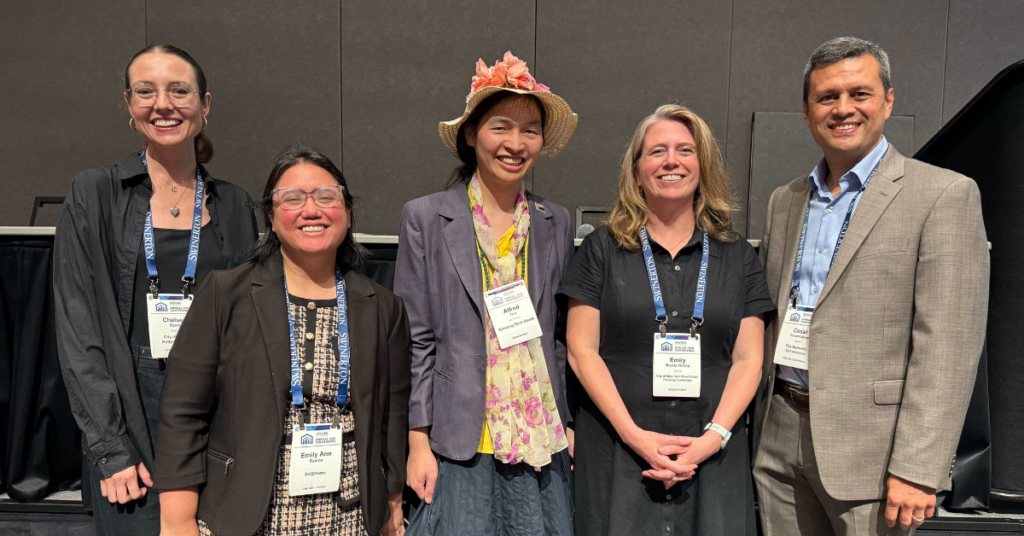
At the Housing California Conference, leaders from Berkeley, West Hollywood, Santa Ana, and Mountain View came together to share real-world lessons on adopting and implementing rent stabilization. Convened and moderated by Emily Ann Ramos of SV@Home, the panel highlighted how policies evolve over time, the importance of strong program infrastructure, and why rent stabilization does not appear to hinder housing production when paired with broader housing strategies.
As more cities across California explore rent stabilization, local leaders are increasingly looking to jurisdictions with lived experience to understand what works and what challenges to expect. At a recent Housing California panel, “Lessons from the Frontlines,” convened, organized, and moderated by Emily Ann Ramos, Tenant Protection and Empowerment Associate at SV@Home, practitioners and policymakers from Berkeley, West Hollywood, Santa Ana, and Mountain View shared insights from decades of implementation and advocacy.
Emily Hislop of the Mountain View Rental Housing Committee opened the session with a statewide overview, highlighting how rent stabilization has evolved across three key eras: pre–Costa-Hawkins jurisdictions, cities that adopted policies between Costa-Hawkins and the Tenant Protection Act of 2019, and the wave of newer programs emerging after 2019. She noted that some newer jurisdictions have already seen modifications or even repeals, underscoring the importance of durable policy design and ongoing community support.
Alfred Twu of the Berkeley Rent Board reflected on Berkeley’s long-standing program, emphasizing the importance of clearly defining what is covered within a rent stabilization law. While Berkeley is often used as a point of comparison or criticism, Twu emphasized that the city takes pride in its leadership and the strong tenant protections it has built over time.
Councilmember Chelsea Byers of West Hollywood shared that her city was founded, in part, to enable the adoption of rent stabilization. As one of the earliest adopters, West Hollywood has long embraced a progressive approach, pairing rent stabilization with broader community values, including a strong commitment to LGBTQ+ inclusion and dense, urban development.
Cesar Covarrubias of The Kennedy Commission detailed Santa Ana’s more recent and hard-fought path to rent stabilization. The city’s journey included a failed citizen initiative, a council-adopted ordinance, significant political opposition including a recall effort, and ultimately, voter approval of the policy in 2024. His remarks highlighted the importance of persistence, coalition-building, and adapting strategies in response to changing political conditions.
During the moderated discussion, Ramos guided panelists through key questions on policy design, implementation, and outcomes. A central topic was whether rent stabilization impacts housing production. Across jurisdictions, panelists consistently noted that they have not seen evidence that rent stabilization slows development. They pointed to state law limitations, such as Costa-Hawkins exempting new construction, and emphasized that local zoning and land use constraints play a far more significant role in limiting housing supply.
The panel also explored the differences between voter-approved and council-adopted ordinances. While council action can be more nimble, panelists noted that voter-approved measures may offer greater long-term stability and protection from political shifts.
In discussing implementation, panelists emphasized practical lessons for cities just getting started. Key recommendations included establishing a rent registry early, partnering with community-based organizations to build trust and awareness, and allowing flexibility in administrative details rather than over-prescribing them in the ordinance itself.
Ultimately, the panel reinforced that rent stabilization is not a one-size-fits-all policy, but a dynamic system that evolves over time. Cities that succeed are those that pair strong tenant protections with thoughtful implementation, community engagement, and a willingness to adapt as they learn.
Written by Emily Ann Ramos, Tenant Protections & Empowerment Associate