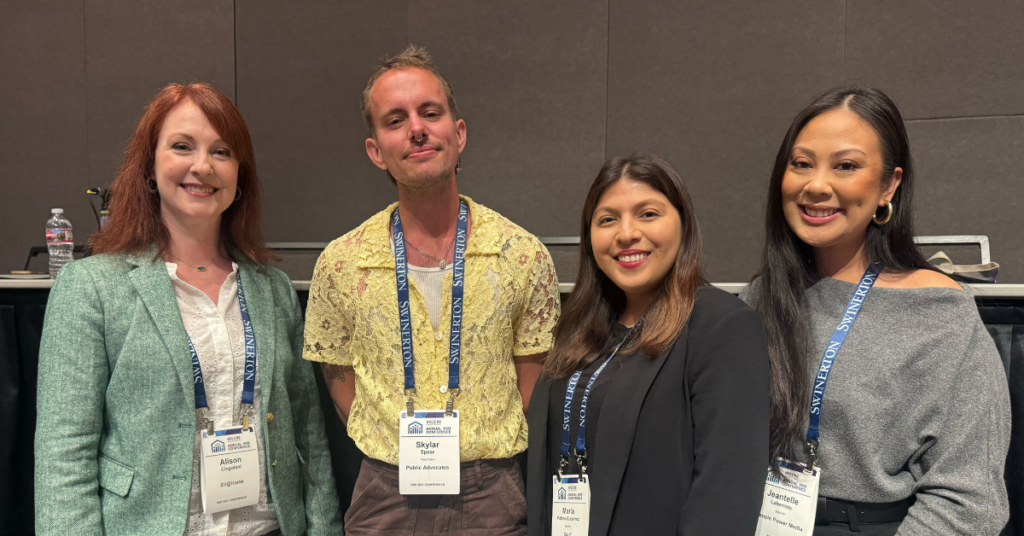
Housing California’s 2026 Conference brought together housers from across the state to connect, learn, and build momentum for action. SV@Home’s Alison Cingolani was proud to join partners from across California for a panel exploring an often-overlooked piece of the state’s affirmatively furthering fair housing (AFFH) mandate- and what it means for local housing plans.
Housing California’s 2026 Conference is one of the state’s largest gatherings of housers, and an amazing place to gather, connect, and learn. Alison Cingolani, Director of Policy, was proud to represent SV@Home on a panel with partners from across California to explore an aspect of the state’s mandate to affirmatively further fair housing (AFFH) that is often unaddressed in local jurisdictions’ housing plans. View slides here.
California law defines AFFH as taking meaningful action to overcome segregation, reduce disparities in access to opportunity, and transform historically excluded communities into places where residents can thrive. However, the investment that transforms historically disinvested places must be thoughtful, strategic, and planned in deep partnership with community to ensure it meets the needs of the people who are there now, rather than simply importing wealthier residents. Across urban, suburban, and rural communities, advocates are showing what that looks like in practice.
In San Francisco, the Race & Equity in All Planning Coalition (REP-SF) has built a powerful model of community-led housing justice. Their Citywide People’s Plan helped shape the city’s Housing Element by centering three core principles: follow community expertise, put affordable housing first, and protect tenants from displacement. That work has already helped secure important “equity actions,” including land banking for affordable housing, stronger support for nonprofit acquisition of tenant-occupied buildings, and investments in community-led neighborhood plans. At the same time, advocates successfully pushed for a Tenant Protections Ordinance to provide clearer safeguards for residents facing demolition and redevelopment.
In South Los Angeles, community groups like SAJE and the UNIDAD Coalition demonstrated that equitable development must ask not just whether development happens, but for whom. Their organizing won stronger affordable housing requirements, expanded replacement housing rules, demolition protections, support for small businesses and street vendors, environmental justice gains, and the city’s first “no net loss” monitoring program. Their work is a reminder that streamlining without equity guardrails can produce harmful unintended consequences.
In the Central Valley, advocates adapted AFFH strategies to very different local realities. In places like Bakersfield, Madera County, and Merced County, limited funding, conservative political environments, and infrastructure deficits have shifted the focus toward practical, community-driven solutions: local tenant protections, exploring TOPA/COPA policies, community land trust strategies, water and utility affordability programs, buffer zones from pollution, indoor air quality improvements, and stronger oversight of flood recovery and industrial impacts. In these communities, fair housing is inseparable from environmental health, infrastructure, and basic quality of life.
Here in Santa Clara County, Alison highlighted another urgent opportunity: making it possible for surplus school district land to meet community needs for affordable housing and community-serving uses. As countywide public school enrollment continues to fall- especially among younger students, driven in part by housing costs- school sites can become powerful assets for teacher housing, affordable homes, early learning centers, and community spaces that keep families rooted in place.
Across California, AFFH is not just about increasing housing production. It is about ensuring that public policy repairs historic harm, protects existing residents, and creates communities of opportunity.
That’s why SV@Home is helping advance a Reinvestment Without Displacement Toolkit—a set of community-driven, actionable strategies for local governments to pair housing growth with tenant protections, land acquisition, community ownership, and equitable reinvestment.
Because the goal isn’t just more development, it’s a California where everyone can afford to stay, belong, and thrive.
Written by Alison Cingolani, Director of Policy