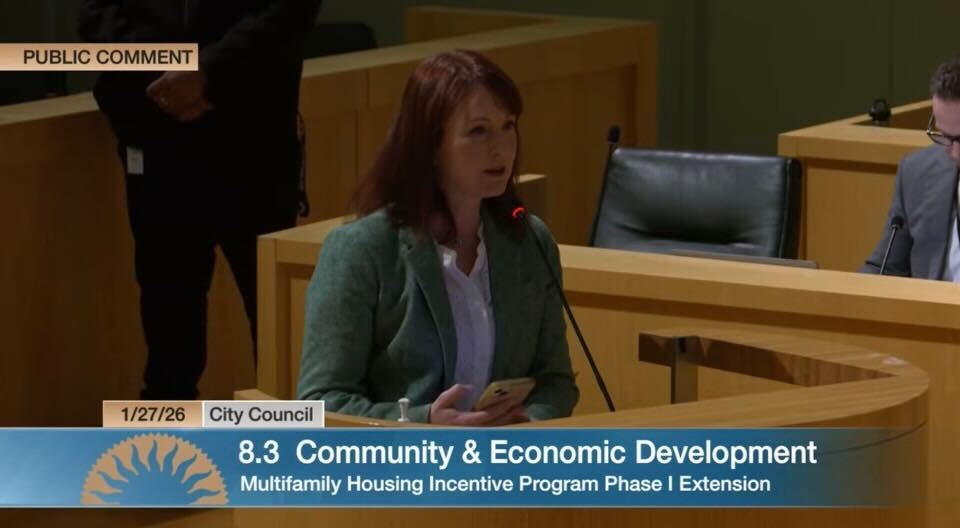
It was a mixed bag in San Jose on Tuesday, January 27th with Council decisions that included both significant wins and some disappointing outcomes over nearly nine hours of Council deliberation.
We will continue to advocate fiercely for all our cities and towns across Santa Clara County to make decisions about housing that are rooted in real and robust data and analysis, driven by the housing needs of their full and diverse communities, and informed by the insights and experience of key stakeholders.
There was some movement in this direction from San Jose’s Council, as direction on the Inclusionary Housing Ordinance (IHO) included a Memorandum from Councilmember Ortiz, strongly supported by SV@Home, directing staff to return to Council by March 10th with a Memo on Alternative Funding Options for Promoting Affordable Housing Development, as well as an assessment of the number of deeply affordable homes these funds could support, strategies for creating new sources of funding, and data on the housing needs of residents across all income levels.
Council direction on the Mobilehome Rent Ordinance (MRO) requires City staff to deeply engage with both mobilehome residents and mobilehome park owners to arrive at collaborative solutions that both protect residents and enable necessary infrastructure investment. Staff must also analyze the impacts of space rent changes on the resale value of mobilehomes.
We will continue to advocate for City staff to be empowered with the resources they need to approach all the work that so deeply impacts the lives of San Jose’s residents with this level of breadth and depth, to inform Council deliberation and produce the best outcomes for the people who call this city home.
We are proud of the work of SV@Home’s staff and partners, who hosted educational events and participated in more than two dozen meetings to share our perspectives and concerns with councilmembers and their staff, as well as staff in the Housing Department and Planning, Building, & Code Enforcement (PBCE) Department. Many of the items below involve components that City staff will work on and bring back to Council for presentation or deliberation. We will continue to engage and keep you informed as that happens.
SB-79
Staff Seeks Council Direction to implement Senate Bill 79: Upzoning Near Transit (exempts land set aside for business/employment uses from the state’s SB79 requirements meant to spur housing production near transit and job centers)
The Memorandum from Mayor, Campos, Tordillos & Cohen, which SV@Home supported, passed unanimously:
- Direct staff to return to Council in March 2026 with a draft ordinance exempting nonresidential sites within qualifying industrial areas identified in the General Plan as Employment Areas from the provisions of Senate Bill 79.
- Do not direct staff to return to Council with an ordinance exempting designated historic resources from SB 79 implementation. SV@Home note: historic resources continue to be subject to the California Environmental Quality Act, which offers significant protections for historic structures.
- Direct staff to return to Council with an ordinance increasing minimum densities in the downtown core.
- Assess options for increasing minimum densities in other growth areas, based on further analysis.
The City is on a tight timeline to execute this complex work, as they must submit their alternative plan to the California Department of Housing & Community Development for review by March, as the law takes effect July 1, 2026.
Notably, VTA expressed concern that it has planned significant residential density at two station areas the City plans to exempt as Employment Areas. PBCE staff expressed that they need to exempt these areas from SB 79 now to meet the deadline, and voiced commitment to continued work with VTA to add housing back as an allowable use to parcels within these areas.
All SB 79 developments must contain a percentage of affordable housing on site, as they are subject to either the City’s or SB79’s inclusionary requirements, whichever is stronger.
Downtown Residential Incentive Program
Expansion of the Downtown Residential Incentive Program (eliminates the inclusionary affordable housing requirement and significantly reduces construction taxes for certain new market-rate housing developments and office-to-residential conversions in Downtown)
The Memorandum from Mayor, Foley & Tordillos passed unanimously, with a friendly amendment directing staff to explore additional incentives for developers who provide healthcare subsidies to workers.
This decision added office-to residential conversions and midrise-height buildings to a program that waives certain fees and taxes and removes the requirement for inclusionary units from dense residential developments in Downtown. A phased approach gives greater incentives for developments that receive building permits sooner. The Mayor et al. memo removed the explicit timeframe from the phasing, instead aligning the phasing to unit count, and increased the number of new-construction units eligible for the greatest incentives to 7,000. It also established additional incentives with a greater reduction in fees to incentivize implementation of prevailing wage requirements and skilled apprenticeship programs.
Multifamily Housing Incentive Program
Expansion of the Multifamily Housing Incentive Program (reduces inclusionary affordability standards to 5% at 110% AMI, reduces construction taxes for qualifying developments in growth areas)
The staff recommendation, which SV@Home supported as a temporary means of addressing the uniquely high costs and economic risk of this moment, passed unanimously. Staff noted that this program supports both market rate and affordable housing developments.
Inclusionary Housing Ordinance
Proposal for modified affordability in the Inclusionary Housing Ordinance (IHO) (changed rent requirements on market-rate development for inclusionary units, shortened the time these homes stay affordable, and streamlined the compliance process)
The following provisions passed 9-2:
- The Memorandum from Councilmember Ortiz, directing staff to return to Council by March 10th with an Informational Memo on Alternative Funding Options for Promoting Affordable Housing Development, as well as data on the housing needs across all income levels, an assessment of the number of deeply affordable homes these funds could support, and strategies for creating new sources of funding.
- Developers have 3 options to fulfil the onsite inclusionary requirement:
- Build 5% of units at 30% of AMI, OR
- Build 7% of units at 50% of AMI, OR
- Build 5% of units at 60% of AMI AND 5% of units at 80% of AMI.
- The length of time these homes remain affordable was shortened from 99 to 55 years
- Developments of less than 20 units are exempt from the IHO
- 100% affordable developments are handled in a faster and more streamlined process
- Makes it easier for developers to exchange surplus inclusionary units to fulfil requirements in other developments
While the new requirements will produce fewer deed-restricted affordable apartments, we are pleased that compliance options include the deeper levels of affordability (30% and 50% of AMI) that serve residents who struggle to compete in San Jose’s housing market, where average rent is affordable at about 70% of AMI.
However, since there was no analysis of the feasibility of any combination of depth of affordability and percentage of total units, it remains unclear whether these three options are roughly equivalent in their cost, or which option developers might prefer.
We encourage the City of San Jose to bring back consideration of the Inclusionary Housing Ordinance in the near future, informed by thorough analysis and outcome modeling, deep stakeholder engagement, and feasible alternatives to support Council deliberations.
Mobilehome Rent Ordinance
Changes to Mobilehome Rent Ordinance (amends the MRO only to comply with new state law)
Council unanimously rejected changes to the MRO, except those required to comply with Assembly Bill 2782. Council directed the City Manager or her staff to hold meetings of mobilehome residents and mobilehome park owners to reach a collaborative agreement that both protects residents and ensures owners can responsibly meet critical operating expenses and infrastructure investment needs.
Staff must also conduct an outreach campaign to mobilehome owners, explore alternative options that could generate revenue for mobilehome park owners, and analyze the impact of a 10% increase in space rent on the resale value of the mobilehome.
Soft Story Pilot Program
Soft Story Retrofit Pilot Finance Program (will shift $1.6 million in City funds to finance seismic retrofits in up to 20 vulnerable residential buildings)
Council unanimously passed staff’s recommendation, creating a pilot program estimated to finance the seismic retrofit of 15-20 vulnerable buildings on a first come, first served basis. Since most of the anticipated federal funding to support the Soft Story program has been withdrawn, staff indicated they plan to return to council with a recommendation to delay the implementation timeline by another year.