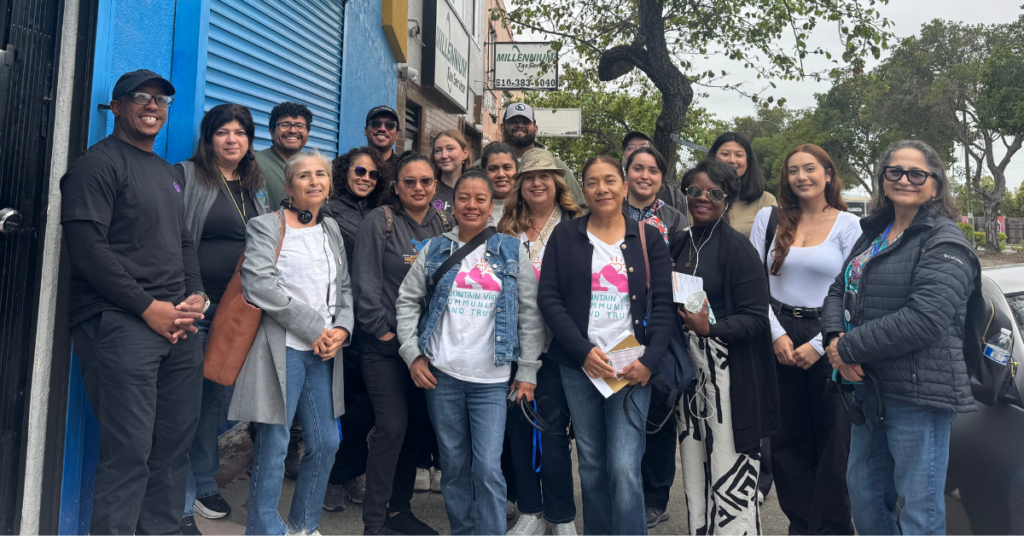
The Community Roots Collaborative (CRC) recently visited the Black Cultural Zone Community Development Corporation. Last time we visited BCZ, we were only able to visit Liberation Park and learned how it has served as a temporary hub to meet the various needs and desires of the East Oakland community. The burgeoning CDC acquired several properties since then that support their housing, small business incubation, and direct service programming and partnerships throughout East Oakland.
The Community Roots Collaborative (CRC) recently visited the Black Cultural Zone Community Development Corporation. Our first visit two years ago was cut short due to a mishap (we got stuck in an elevator), so it was overdue to go back to Oakland. Last time we visited BCZ, we were only able to visit Liberation Park and learned how it has served as a temporary hub to meet the various needs and desires of the East Oakland community. After visiting BCZ CDC this time around, we learned that Liberation Park is due for a groundbreaking later this year for its transformation into a market hall and cultural hub with roughly 119 affordable homes, filled with a museum, storefronts for Black brands, healthy food options, coworking spaces, and more. On this tour, we learned that the activation that Liberation Park has had wasn’t a standalone occurrence. All properties that BCZ CDC own are activated before any construction happens with the intent to build familiarity, culture, and a sense of ownership in these spaces.
Since 2024, BCZ CDC has grown significantly! From a staff sized at roughly 30-40 to now over 200 employees. The burgeoning CDC acquired several properties that support their housing, small business incubation, and direct service programming and partnerships throughout East Oakland. The CRC also learned about the full extent of the work from a geographic perspective, where BCZ CDC and their partners are committed to healing and revitalizing East Oakland by a 40 by 40 block area, known as the “40×40” through the Rise East Initiative. Within this 40 x 40 block area, the BCZ CDC tour covered lots of ground, showing how enriching, diverse, and successful their programming and work has come along. Each stop the CRC made in Oakland is deserving of an entire article within its own right, but for now we’ll share quick bullets of a few other places we visited:
- Sankofa Sanctuary: Kicking off here for coffee, pastries, and a small introductory presentation of BCZ CDC, this space is owned, operated, and designed by BCZ CDC as for local gathering, arts, and a collaborative culture.
- Dojo Campus: Another BCZ-acquired property currently under rehabilitation with a rich history in martial arts with a vision to have it be an anchor for community uses, event spaces, and cultural empowerment.
- Macarthur Boulevard Residential Properties: We visited and met tenants with lived experience homelessness of a rehabilitated, beautiful apartment complex.
- The Hook & Net/Safety Ambassadors: A former and adored seafood restaurant with visions of re-opening, this stop is temporarily the hub for BCZ CDC’s remarkable Safety Ambassador program. CRC got to meet staff dedicated to improving safety and cleanliness, connecting people to city resources, and overall elevating community connection. Safety Ambassadors actively recruit new community members, which is an attractive opportunity given that BCZ CDC pays safety ambassadors while offering an 18-month workforce development program, providing GED workshops, professional training, and creating employment opportunities.
- Roots Community Health: BCZ has partnered with Roots Community Health who offer workforce development and life-building opportunities for people exiting the incarceration system. One of their employment programs that the CRC visited was the warehouse and storefront where the training, manufacturing, and sale of soaps, candles, and other hygiene/wellness products happens.
We met CEO, Carolyn “CJ” Johnson during the tour, and she shared about her upbringing in East Oakland, her profession in real estate, and her eventual commitment with the BCZ. We learned about how her approach to development is deeply tied to the arts, culture, and economic well-being of the people in East Oakland.
We took a lot of notes and look forward to having an extended discussion in our next meeting in July on how we can bring BCZ CDC’s strategy, energy, and passion back to Santa Clara County.