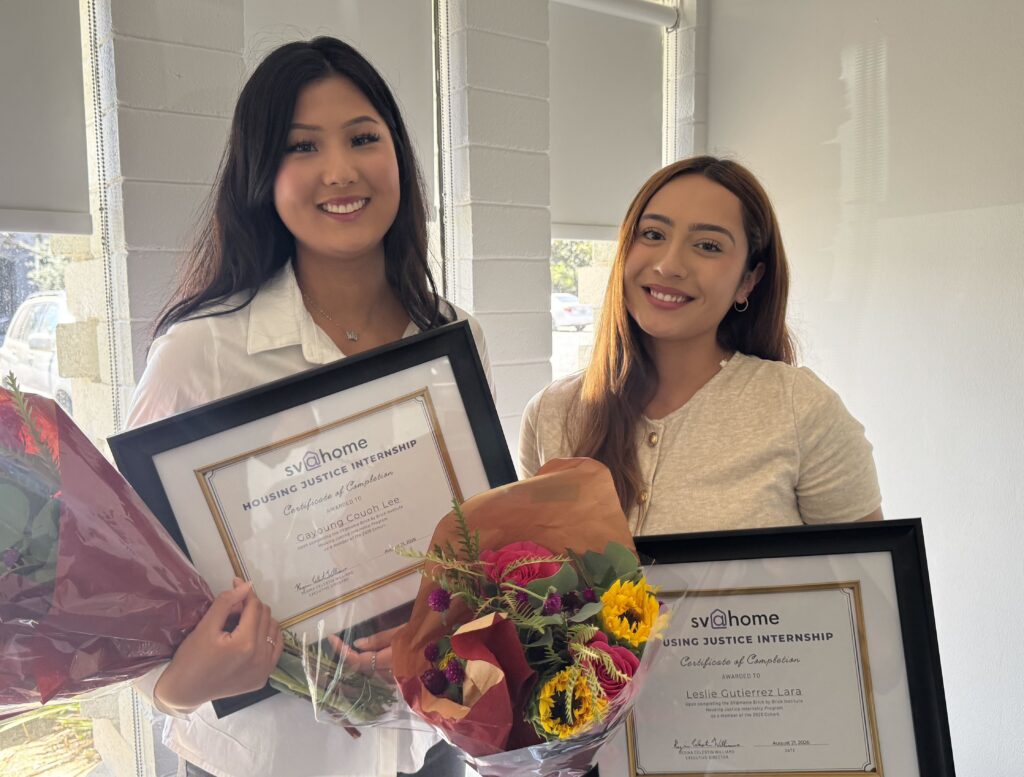
We had the pleasure of working with Santa Clara University students Gayoung Couoh Lee and Leslie Gutierrez Lara through our 10-week summer internship. Just one year away from graduating, we excitedly invited them into our space to work alongside us on important research projects that advance our work.
Gayoung’s Research on San Francisco’s Small Sites Program
Gayoung dove deep into the world of community-based development by studying the City/County of San Francisco’s (SF) Small Sites Program (SSP), a program that funds community-based developers (CBDs) to acquire, rehabilitate, and maintain rental properties to permanently convert them into affordable housing for low-to-moderate income tenants. Her project examined how the program helps preserve existing housing, preventing displacement and maintaining long-term affordability for tenants.
Gayoung interviewed representatives from several CBDs who benefited from the SSP. The organizations include, Mission Economic Development Agency (MEDA), Chinatown Community Development Center (CCDC), and the San Francisco Community Land Trust (SFCLT). She also (importantly) interviewed the San Francisco Mayor’s Office of Housing and Community Development (MOHCD), who manages the program itself. The interviews helped Gayoung better understand the successes and the challenges of the SSP, including pieces of the program they would like to change and tips they recommend other jurisdictions in Santa Clara County use to start their own version of the SSP.
After analyzing the interview data she collected, Gayoung found:
- Success: The SSP helped people. Hundreds of homes are preserved and affordable for the next 99 years, protected from the speculative market while helping small CBDs develop their portfolios and gain experience in acquiring, rehabilitating, and maintaining homes.
- Challenge: The main challenge with SSP is long-term funding for the program itself to continue its mission alive and preserve more properties continually. A secondary challenge was a 25-day timeline to contact tenants, produce an offer, and gain buy-in to acquire the property. Some tenants didn’t understand that although some of their rents would go up slightly (especially for rent-controlled units), their property wouldn’t at-risk of being flipped, for example.
- Change: One thing many interviewees shared was that the Housing Accelerator Fund was critical to the program’s success. Without this Community Development Finance Institution, they would not have been able to meet the tight closing timeline of 60 days that the SSP required. One change would be to allow for a slightly longer timeline of 90 days and hold the property for CBDs who can be outcompeted by bigger market forces
- Recommendation: Although SF’s Community Opportunity to Purchase Act (COPA) was tied to the SSP, it didn’t come online until right before the pandemic hit — when the SSP’s program funding was reduced and political changes deprioritized it. COPA is essential in structurally supporting CBDs the opportunity to try and close the property again if they missed the 60-day aforementioned deadline.
Gayoung hopes her research can help demonstrate that preventing displacement requires more than building new housing — that it also requires preserving existing homes, supports the work of community based developers who look out for the “little people”, and importantly, allows residents and communities to continue to be rooted in long term stability.
Leslie’s Assessment on Enhanced Infrastructure Finance Districts
Leslie entered the world of Enhanced Infrastructure Finance Districts (EIFDs), a municipal tax increment finance diversion tool that helps put more money into certain areas in a city for community development projects, including affordable housing production and preservation — without raising new taxes. This is a new tool created by the state when the Redevelopment Agency was disbanded, but it has seldom been used. EIFDs are eligible for about 20 other uses, such as improvements to transit stations, infrastructure, and public facilities.
SV@Home is working with the Valley Transportation Authority to conduct a feasibility analysis for creating EIFDs within Santa Clara County cities. And as part of her research, Leslie supported this work by visiting six transit-rich areas throughout the county to gather information and make the case for creating EIFDs. They included:
- Whisman Light Rail station in Mountain View
- Sunnyvale Station
- Berryessa BART, Alum Rock & Jackson, Tamien Caltrain, and Cottle Light Rail Stations in San Jose
At each of these stations, she conducted a site analysis from a 0.5 miles-wide radius. Leslie drove by and walked through surrounding neighborhoods of each station, documenting and taking pictures of vacant lots, types of homes, and key (or missing) neighborhood amenities (i.e. schools, hospitals, grocery stores). Along with her on-site observations, Leslie gathered deeper data from public sources (e.g. City of San Jose’s Housing Site Explorer, the U.S. Census Bureau, etc.) to better understand the demographic makeup of each station area. She also reviewed local zoning maps of these potential EIFDs to identify land uses and possible development opportunities and constraints. Leslie only had time to more deeply review three areas at Berryessa BART, Tamien Caltrain, and Alum Rock & Jackson stations. In all three stations, she found:
- Underused and low-density land use;
- High housing cost burden; and
- Latino communities lived near Industrial land uses or in mobile homes.
Leslie had the following key recommendations from her findings to convince cities to form EIFDs in their station areas:
- Use EIFDs to capture transit-related growth and reinvest in affordable housing and anti-displacement;
- Work with nonprofit organizations to set goals and criteria for each district
- Build a basic understanding of existing neighborhoods, amenities, and conditions
Gayoung and Leslie worked hard to finish their interviews and site assessments to support SV@Home’s critical work. We’d like to congratulate Gayoung and Leslie for their hard work, passion, and kindness throughout the 10 weeks they were with us. They will be missed!