There is more work ahead to support community-serving uses across all school & faith properties. Plus, positive recommendations on streamlining urban villages and increasing overall residential density.
On Wednesday night San Jose’s Planning Commission, which has also been serving as the General Plan 4-Year Review Task Force, finalized their recommendations to the City Council. Council will consider these recommendations and provide direction to staff on August 18th. Learn more about the Review process to date.
We invite you to join us on Friday, August 7th from 9:30-11am at the SV@Home office for Policy & Pastries, an informal monthly event. In August, we will be discussing the opportunities presented by the ongoing General Plan 4-Year Review in San Jose. RSVP here.
The current Review has focused on a limited set of topics and potential changes that align with the scope of work approved by the City Council. The work of the General Plan Review supports the completion of several programs from the City’s Housing Element, a state-required plan for the City to meet the housing needs of its residents at all income levels, and plan for future growth.
Our Positions on the Planning Commission’s Recommended Actions
For the most part, the Planning Commission advanced staff’s recommendations to Council, and SV@Home supports these recommendations with one important exception, which is both urgent and deeply connected to the long-term health and affordability of San José: the future of public school and faith-owned land.
We Oppose the Planning Commission’s Recommendations Limiting Community-Serving Uses on School and Faith Lands.
As declining enrollment and smaller congregations both threaten financial sustainability and change land needs for school districts and faith communities, they need a clear, simple, flexible, and expedient path to both leverage their land for long-term sustainability and continue to serve their communities as important anchor institutions.
SV@Home strongly supports an expansion of permitted community-serving uses on all school and faith lands, including affordable family or senior housing, educator and public workforce housing, childcare centers, community health services, nonprofit offices, neighborhood-serving retail, recreational facilities, cultural spaces, or other community-serving uses.
SV@Home urges Council to direct staff to expand permitted uses across all public school and faith-owned sites, except those located in high fire risk areas. Doing so would preserve local discretion while giving school districts, faith institutions, and communities the flexibility to determine together how these properties can best serve San José’s evolving needs for generations to come.
We oppose the recommendation going to Council in August, which would limit the expansion of allowable community-serving uses to some sites but not others, as we believe this could unintentionally interfere with the difficult decisions school districts and faith congregations must make in close partnership with their communities. It would also create equity impacts, as options available to one school district, community, or faith congregation may not be available to another. Finally, an uneven approach is likely to accelerate the loss of school and faith sites to non-community uses. School districts and faith communities that lack the resources to navigate a lengthy and uncertain approval process may be forced to sell their land outright rather than retain ownership and redevelop it in ways that both strengthen their long-term financial sustainability and continue serving the community.
Most of these properties carry a Public/Quasi-Public (PQP) General Plan designation, and both school districts and faith communities are confronting profound demographic shifts that are reshaping how their land is used and what their communities need.
Public elementary school enrollment in San José has fallen by 27 percent—nearly 18,000 students—in the decade leading up to 2025. School districts are making difficult decisions, in partnership with their communities, to close and consolidate schools in response. While declining birth rates are one factor, the loss of families with children due to rising housing costs and displacement is also contributing to enrollment declines. Put simply, many schools are serving fewer students because fewer families can afford to live in San José.
This reality creates an opportunity to address both the symptom and the cause. As districts evaluate underutilized or surplus properties, they should have the flexibility to leverage those sites to create the housing and community-serving uses that help families remain in San José. Family housing, affordable housing, childcare, and neighborhood services can strengthen communities while also helping stabilize future school enrollment. In this way, school-owned land can become part of the solution to the very challenges driving school closures.
However, the current PQP framework limits the ability of school districts and faith communities to pursue these outcomes. Restrictive land use rules create barriers to redevelopment and can leave institutions with few viable options beyond selling land outright. Expanding permitted uses would provide a clearer path to retaining ownership, generating ongoing revenue, meeting community needs, and preserving the role of schools and faith institutions as long-term community anchors.
The need for action is growing increasingly urgent. Enrollment declines and changing demographics are placing mounting pressure on school districts and faith communities throughout San José, and additional closures are likely in the years ahead. The City should ensure these institutions have the tools necessary to respond thoughtfully and strategically.
We support the Planning Commission’s Recommendations Streamlining Urban Village Planning, Increasing Residential Capacity, and Enabling Missing Middle Housing.
Urban Villages are identified growth areas intended to provide active, walkable, bicycle-friendly, transit-oriented, mixed-use urban settings for new housing and job growth, attractive to an innovative workforce and consistent with the General Plan’s environmental goals. Each Village must have an adopted plan before residential projects can be allowed, with the exception of 100% affordable housing developments and Signature Projects (large mixed-use projects that meet a specific set of requirements).
The General Plan designates 62 Urban Villages, but because it also stipulates a customized, complex, and lengthy planning process for each one, only 16 plans have been adopted (with 2 more in progress) since the General Plan was approved in 2011.
The Planning Commission’s recommendations would provide a quicker and clearer path for remaining Urban Villages, by consolidating Villages with shared characteristics into a single plan, addressing the smallest Villages through simpler land use changes, clearly defining the outreach process, and simplifying plan documents.
Increasing density in neighborhoods zoned for single-family housing is key to allowing neighborhood-scale (often referred to as missing middle) or small multifamily housing.
The Planning Commission recommended that Council direct staff to increase the allowable density up to 32 homes per acre in neighborhoods currently limited to just 8 homes per acre. This density, already present in many of our historic neighborhoods, will enable a greater variety of housing types to meet a diversity of housing needs. Read the coalition letter signed by SV@Home.
Missing Middle Housing is essentially house-scale buildings with multiple units in walkable neighborhoods. They are compatible in scale and form with detached single-family homes and include duplexes, fourplexes, cottage courts, courtyard buildings, among others.
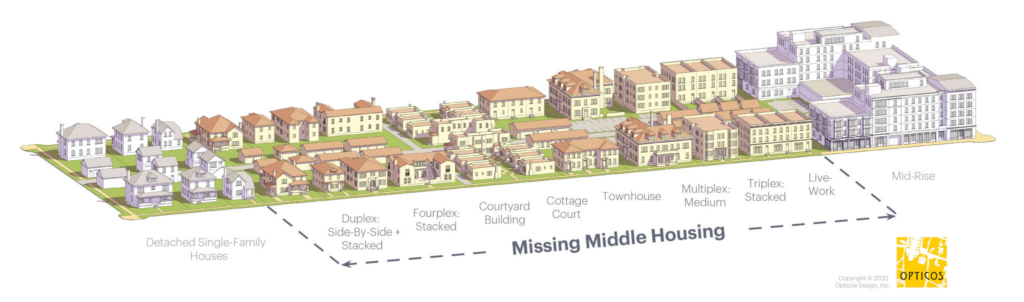
(Image Source: Opticos Design, Inc.)
Watch the recorded Planning Commission meeting
View the City’s full catalog of General Plan Review materials