
For nearly a year we have been telling you about San Jose’s General Plan 4-Year Review, a required process that updates the document that serves as the City’s land-use constitution. On August 18th, San Jose’s Council will make decisions about two SV@Home priorities that could have enormous implications for how many homes can be built in the city in the coming years.
Take These Three Actions:
- Call or email your councilmember and the Mayor (copy the City Clerk), and tell them to:
- Remove barriers to building housing and community-serving uses on faith and school lands. Specifically, on all school and faith land citywide, allow affordable housing development without the current 25% requirement for permanent supportive housing (PSH) in addition to allowing education and public workforce housing development and community-serving uses, ending the proposed requirement for a long and expensive general plan amendment or special use permit.
- Expand housing opportunities in single family neighborhoods citywide, without imposing new barriers to more homes. Specifically, enable neighborhood scale “missing middle” housing throughout San Jose (94% of the city is zoned for single-family homes) by increasing density to 32 units per acre within single-family zoning. This increase in density would allow buildings like fourplexes, triplexes, and small apartment buildings across the city. Do not reintroduce parking requirements, which increase housing costs and take up space that could be homes for people, not cars.
- Sign your organization on to the Coalition Letter in support of removing barriers to building housing and community-serving uses on faith and school lands. Click here for the letter.
- Come speak at the August 18th City Council Meeting! With a packed agenda, it is likely that speakers will have just 1 minute or less to speak. Use the short script above, or briefly share why this is so important to you!
Learn more about the opportunity on school and faith lands
As declining enrollment and smaller congregations both threaten financial sustainability and change land needs for school districts and faith communities, they need a clear, simple, flexible, and expedient path to both leverage their land for long-term sustainability and continue to serve their communities as important anchor institutions. San Jose’s faith and school sites are zoned public/quasi-public (PQP), so this policy discussion is often referred to as “PQP” for short.
Right now, many land uses that could support the community, support financial stability, and advance the mission of school and faith communities are either not permitted at all or require a special use permit.
- Community-serving uses not allowed at all: 100% affordable housing with no permanent supportive housing, public workforce housing, neighborhood-serving retail, commercial kitchens to support small home-based food entrepreneurs
- Allowed only with a Special Use Permit, which currently takes an average of 806 days for the City to process: Daycare center, social services agency, medical clinic, certified farmers’ market, vocational school, gym, community theater
SV@Home strongly supports removing barriers and expanding permitted community-serving uses on all school and faith lands. One barrier is the current requirement for 25% permanent supportive housing (PSH) in any housing built on PQP land. PSH in Santa Clara County depends on the availability of Section 8 vouchers that can be attached to these deeply affordable units to help cover monthly operating costs (these are known as Project-Based Vouchers). Funding for the Section 8 program is determined annually through the federal budget, is uncertain at the best of times, and is inadequate to meet existing needs (only about 20% of SCC households that qualify for a voucher receive one). Recent changes to funding at the federal level have further strained the voucher program, and no uncommitted vouchers are available for new PSH. Requiring PSH therefore ensures no new housing will be built on PQP sites in the near term.
SV@Home urges Council to direct staff to expand permitted uses across all public school and faith-owned sites, except those located in high fire risk areas. Doing so would preserve local discretion while giving school districts, faith institutions, and communities the flexibility to determine together how these properties can best serve San José’s evolving needs for generations to come.
The proposal coming to Council would create a new framework the City would use to consider certain land use changes on PQP sites, establishing “criteria for determining the appropriate amount and distribution of PQP land and/or sites throughout the city.” This approach
- would continue to require a general plan amendment for each site;
- would limit the expansion of allowable community-serving uses to some sites but not others, which we believe could unintentionally interfere with the difficult decisions school districts and faith congregations must make in close partnership with their communities;
- would create equity impacts, as options available to one school district, community, or faith congregation may not be available to another;
- is likely to accelerate the loss of publicly owned school and faith sites to non-community uses, as many school districts and faith communities lack the resources to navigate a lengthy and uncertain approval process. As a result, these public-serving institutions may be forced to sell their land outright.
Public elementary school enrollment in San José has fallen by 27 percent—nearly 18,000 students—in the decade leading up to 2025. School districts are making difficult decisions, in partnership with their communities, to close and consolidate schools in response. While declining birth rates are one factor, the loss of families with children due to rising housing costs and displacement is also contributing to enrollment declines. Put simply, many schools are serving fewer students because fewer families can afford to live in San José.
This reality creates an opportunity to address both the symptom and the cause. As districts evaluate underutilized or surplus properties, they should have the flexibility to leverage those sites to create the housing and community-serving uses that help families remain in San José. Family housing, affordable housing, childcare, and neighborhood services can strengthen communities while also helping stabilize future school enrollment. In this way, school-owned land can become part of the solution to the very challenges driving school closures.
However, the current PQP framework limits the ability of school districts and faith communities to pursue these outcomes. Restrictive land use rules create barriers to redevelopment and can leave institutions with few viable options beyond selling land outright. Expanding permitted uses would provide a clearer path to retaining ownership, generating ongoing revenue, meeting community needs, and preserving the role of schools and faith institutions as long-term community anchors.
The need for action is growing increasingly urgent, and the opportunity with the 4-year General Plan review is now!. Enrollment declines and changing demographics are placing mounting pressure on school districts and faith communities throughout San José, and additional closures are likely in the years ahead. The City should ensure these institutions have the tools necessary to respond thoughtfully and strategically.
Learn more about missing middle housing
Increasing density in neighborhoods zoned for single-family housing is key to allowing neighborhood-scale (often referred to as missing middle) or small multifamily housing.
Staff is recommending that Council direct staff to increase the allowable density up to 32 homes per acre in neighborhoods currently limited to just 8 homes per acre. SV@Home strongly supports this recommendation. This density, already present in many of our historic neighborhoods, will enable a greater variety of housing types to meet a diversity of housing needs. Watch the City’s great video explaining missing middle housing.
Missing Middle Housing is essentially house-scale buildings with multiple units in walkable neighborhoods. They are compatible in scale and form with detached single-family homes and include duplexes, fourplexes, cottage courts, courtyard buildings, among others.
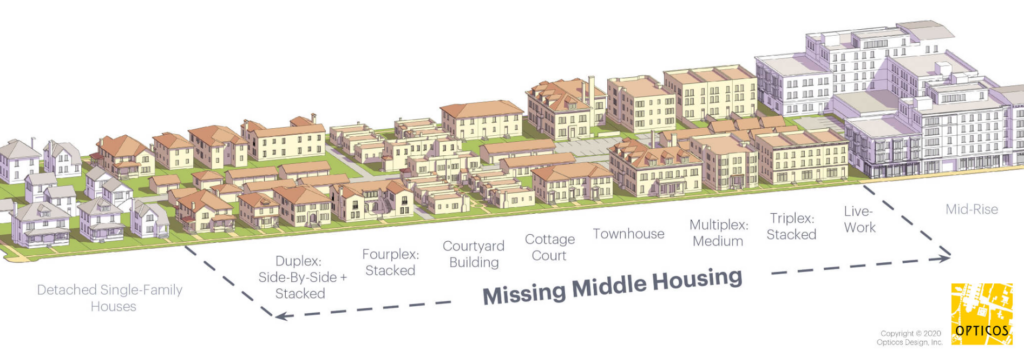
(Image Source: Opticos Design, Inc.)
These housing types already exist in San Jose, with large numbers in some of the city’s most prized neighborhoods (such as the Hensley District, Willow Glen, and the Rose Garden), developed before single family zoning made them illegal. The City’s current density limit in single-family neighborhoods of just 8 units per acre makes these home types difficult to build, despite recent state legislation intended to support them.
Missing middle homes fit seamlessly into existing residential neighborhoods and provide solutions along a spectrum of affordability to address the mismatch between the available housing stock and need. Their smaller footprint and shared land cost lead to lower sale prices, as with San Jose’s recent ADU sale, the first of its kind in California, which sold for less than half the price of a typical single-family home. Missing middle housing is often affordable to moderate-income households and can effectively produce starter homes for families or places for older adults to downsize while remaining in the community. They also support walkability, locally-serving retail, and public transportation options.
For these zoning changes to successfully create more housing opportunities, San José should maintain its current approach of allowing projects to determine the amount of parking they need rather than imposing minimum parking requirements. In 2022, San Jose became the largest U.S. city to remove minimum parking requirements for new developments, recognizing that mandatory parking can increase development costs, consume land that could otherwise support homes, and undermine efforts to encourage walking, biking, and public transit. This approach is increasingly reflected in California policy, including state law that prohibits cities from imposing minimum parking requirements on housing within a half-mile of qualifying high-quality transit. As the City considers allowing more neighborhood-scale multifamily housing, preserving this flexibility will help ensure that new zoning capacity can translate into homes that are financially and physically feasible to build.
Parking spaces are shockingly expensive to build, costing tens of thousands of dollars each. Minimum parking requirements can make small parcels effectively undevelopable with more than one home by mandating more parking than can physically fit on a site.
While staff has not recommended changes to minimum parking as part of Council’s missing middle consideration, the Planning Commission acknowledged community requests for more parking. SV@Home recommends that Council does not add new parking requirements to new housing development.
Get in touch with the Mayor and your Councilmember, and copy the City Clerk!
City Clerk: city.clerk@sanjoseca.gov
Mayor Matt Mahan: mayor@sanjoseca.gov 408-535-4800
District 1 Rosemary Kamei: district1@sanjoseca.gov 408-535-4901
District 2 Pamela Campos: district2@sanjoseca.gov 408-535-4902
District 3 Anthony Tordillos: district3@sanjoseca.gov 408-535-4903
District 4 David Cohen: district4@sanjoseca.gov 408-535-4904
District 5 Peter Ortiz: district5@sanjoseca.gov 408-535-4505
District 6 Michael Mulcahy: district6@sanjoseca.gov 408-535-4906
District 7 Bien Doan: district7@sanjoseca.gov 408-535-4907
District 8 Domingo Candelas: district8@sanjoseca.gov 408-535-4908
District 9 Pam Foley: district9@sanjoseca.gov 408-535-4909
District 10 George Casey: district10@sanjoseca.gov 408-535-4910
Not sure which council district you live in? Look up your address here.