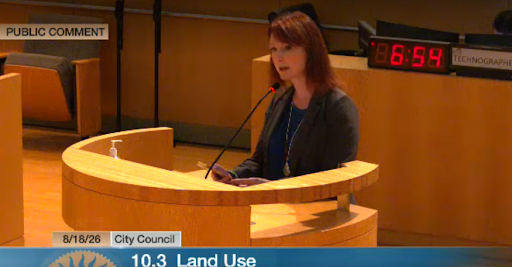
Last Tuesday’s San José City Council action on the General Plan 4-Year Review Policy Framework was an important procedural win for housing advocates, but not yet the final policy decision. Council voted 8–3 to direct staff to study the full set of recommendations advanced by the Planning Commission in the General Plan 4-Year Review framework, with additions and modifications from three different Council memos. Councilmembers Doan, Candelas, and Casey opposed the motion.
The framework Council advanced will guide the work of staff to develop General Plan amendments and ordinances to implement changes to the Plan. It established the outer bounds of what City staff will study through the environmental-review process before returning to Council in December 2027. Council can ultimately narrow the package or choose to adopt less than what is studied, but it cannot add new policies or substantially increase the scope later without triggering additional study. This is why getting the right policies into the study framework now matters so much.
We have kept the door open to meaningful citywide missing-middle reform and expanded PQP flexibility. Now we need to make sure the study produces policies that actually work, and build the political support necessary to ensure Council adopts them when they return in 2027.
While Council’s direction incorporates positive changes, we believe some parts of Council’s direction conflict with the City’s adopted Housing Element and with state law, including Affirmatively Furthering Fair Housing (AB 686, 2018). Housing advocates will need to keep engaging around the changes we need to create more housing opportunities.
The 4-Year Review is required by San Jose’s General Plan, in anticipation that amendments to the Plan will be necessary to address the City’s evolving needs and changing environment. This General Plan Review cycle is focused on complying with the City’s current Housing Element programs and creating substantially more capacity for residential development ahead of the 7th Housing Element.
SV@Home’s advocacy efforts are focused primarily on two General Plan Review goals:
- Housing Element Program P-35 (Small Multifamily Housing), which calls for an expansion of small multifamily housing of at least 4 units and up to 10 units in locations throughout the city, including in high opportunity areas. The California Department of Housing and Community Development (HCD) specifically referenced P-35 in its letter certifying San Jose’s Housing Element, indicating HCD will be closely monitoring the implementation of the program.
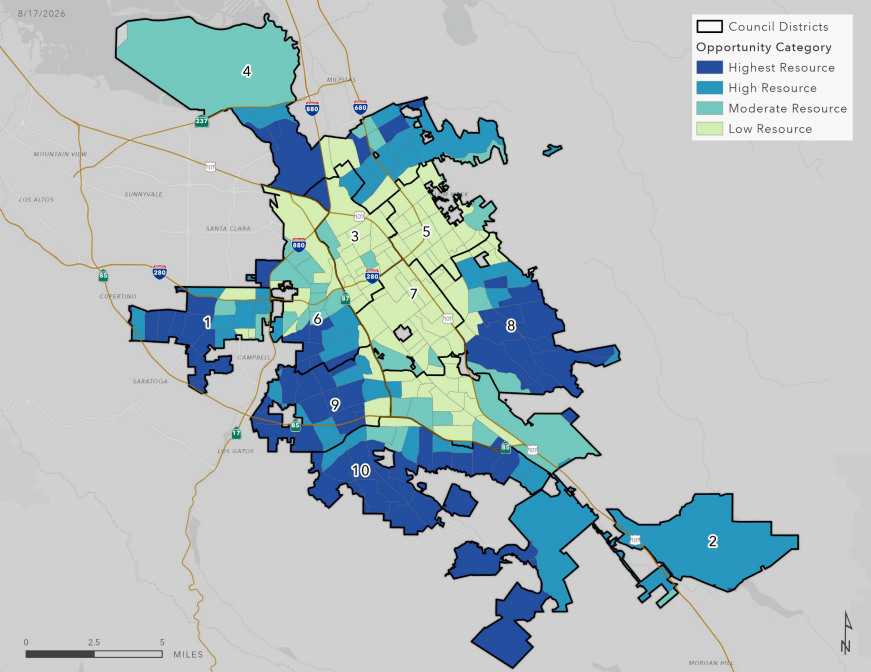
Image source: City of San Jose, Opportunity Area Map. Dark and light blue areas are considered high opportunity. These places have characteristics that correlate to positive life outcomes, but high housing costs and exclusionary land use policies in these areas limit access for lower income families and individuals.
- Removing barriers to building affordable housing and other community-serving uses on land owned by school districts or faith communities, where these communities choose to redevelop land for new purposes. As declining enrollment and smaller congregations both threaten financial sustainability and change land needs for school districts and faith communities, they need a clear, simple, flexible, and expedient path to both leverage their land for long-term sustainability and continue to serve their communities as important anchor institutions. San Jose’s faith and school sites are zoned public/quasi-public (PQP), so this policy discussion is often referred to as “PQP” for short. This issue was not part of the original scope of the 4-Year Review, but the City took it up for consideration in response to advocacy from SV@Home, school and faith leaders, and community partners.
Learn more about these two goals here.
What happened at Council?
For housing advocates, several significant pieces of the package survived. Related to the Small Multifamily Housing program:
- Council declined to clearly define a new density, and instead directed staff to study density increases in residential neighborhood (RN) areas from 8 units to 16, 24, and 32 units per acre. Staff and the Planning Commission both recommended 32 units per acre in order to facilitate 4-10 unit developments and comply with the Housing Element. 16 units per acre is lower than what is currently allowed under state law, and would not enable the minimum number of units required by the Housing Element’s program P-35.
- Housing created under the program could be up to 35 feet/three stories (45 feet and four stories in certain Downtown areas near transit hubs), with a ministerial approval pathway and other objective standards.
- Council directed staff to add a new minimum parking standard in residential neighborhood (RN) areas with low transit access, which would create new cost and spatial barriers to development in wealthier, high-opportunity areas.
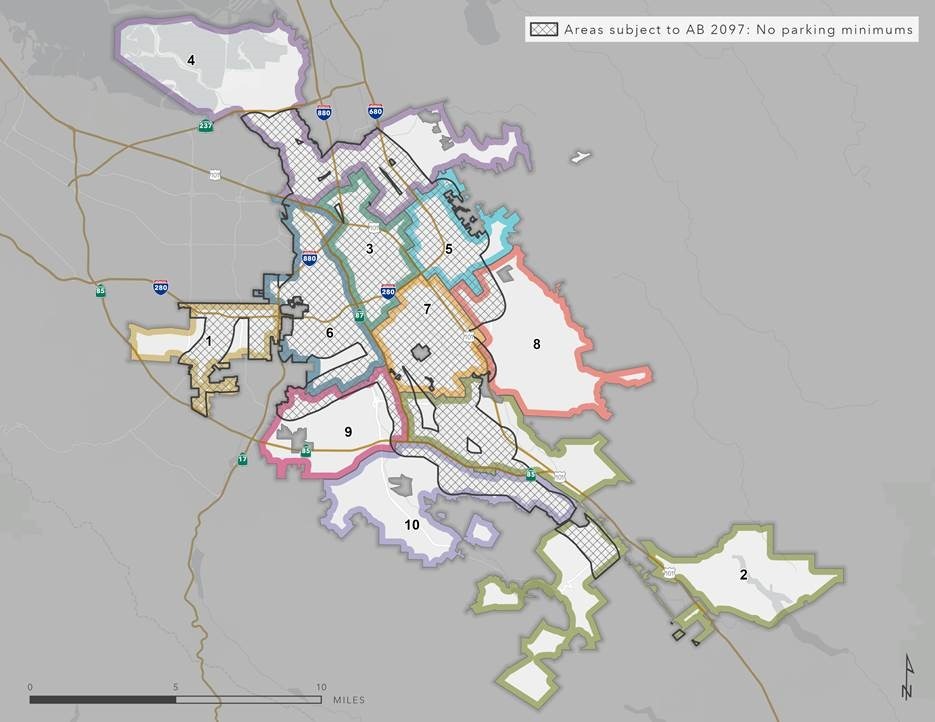
Image source: City of San Jose. Unshaded areas within the city’s boundaries may include new parking minimums, a barrier to development in areas that are primarily high-opportunity.
- Council also directed staff to study excluding small multifamily housing from areas with high vehicle miles traveled (VMT), which would eliminate this housing opportunity from areas that are almost entirely wealthier and high-opportunity.
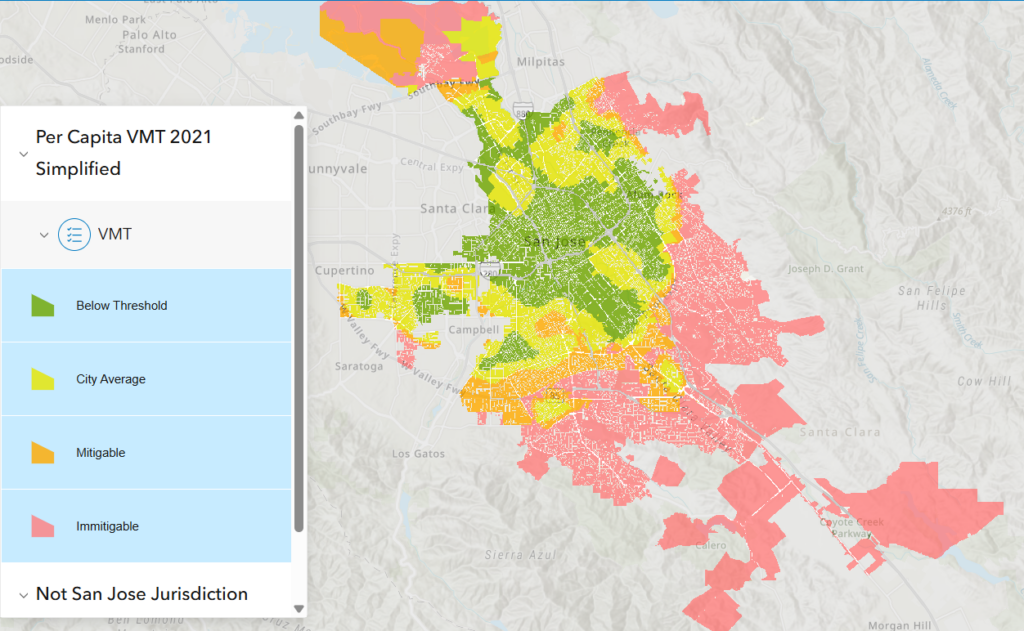
Image source: City of San Jose, VMT per capita. Areas shaded in red, many of which are high-opportunity, would be excluded from the Small Multifamily Housing program.
Related to expanding allowable uses on land owned by school districts and faith communities:
- For sites that are 1.5 acres or less, Council directed a change to allow 100% affordable housing, remove the requirement that 25% of units be permanent supportive housing (PSH), and establish a minimum density of 60 dwelling units per acre. SV@Home advocated for this change because removing a prescribed PSH set-aside gives school and faith communities greater flexibility to develop affordable housing that responds to community needs and project feasibility. At the same time, we remain deeply committed to expanding housing for extremely low-income households and people experiencing homelessness, including PSH.
- Conduct outreach to school districts and faith communities as part of developing a framework to decide which sites would be appropriate for community serving uses. We are pleased that staff’s approach will include community input, but we are concerned that it would leave barriers in place for community-serving uses, including a requirement for a general plan amendment for each site, and allow community-serving uses on some sites but not others.
- Additional direction would reduce the cost of special use permits for community-serving uses and create an additional General Plan Amendment cycle for school and faith lands.
So, the things we need are moving forward. That is significant.
But the politics and rhetoric were disappointing
The less encouraging part was the rhetoric surrounding the debate. Some of the opposition arguments, on the dais and in public comment, were deeply disappointing. The framing of additional housing capacity in established neighborhoods as inherently harmful is at odds with the City’s own housing commitments and with the reality that exclusionary land-use rules have helped produce today’s housing shortage.
The bottom line
This was a meaningful step forward, but it is the beginning of a long process—not the end. Staff now has roughly 15 months to conduct environmental review, technical analysis, and policy development before returning to Council in December 2027. Discussion will continue over what the final policies actually say, how strong the density standards are, what development standards accompany them, and whether Council ultimately adopts the full capacity it has now authorized staff to study.