SV@Home thanks Loghann Bellamy, one of our 2025 summer interns, for her invaluable contribution to this work!
The San Jose metropolitan area has the nation’s third highest cost of living, behind only Manhattan and Honolulu, driven in large part by the high cost of housing. This leaves many workers unable to live in the county whose economy they drive. It also means declines in school enrollment and school closures, as families with young children leave the area for more affordable housing, and fewer people in Silicon Valley choose to have children because of the astronomical cost of living here.
We need housing everywhere, in all our communities, that is accessible and affordable to help relieve financial pressures for young families, so they can stay rooted and thrive here.
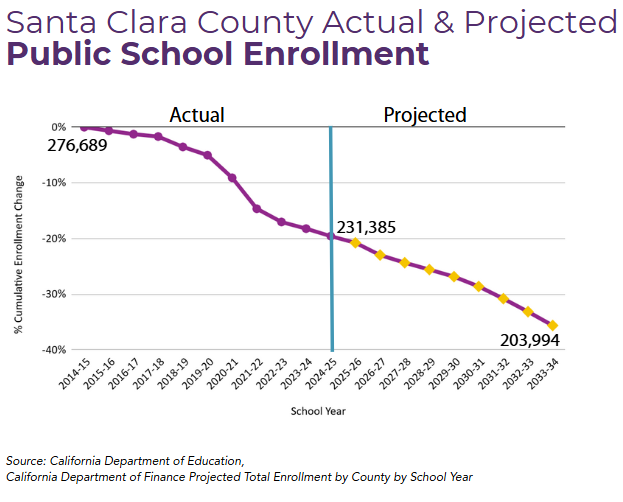
The chart at right shows the cumulative loss from Santa Clara County’s public schools of more than 45,000 students between the 2014-15 and 2024-25 school years. Enrollment projections from the California Department of Finance forecast that a 20-year total decline of 36%, or nearly 73,000 fewer students, is expected without significant changes.
In California, most schools are funded on the basis of student enrollment, so fewer children means less money to keep schools open. School boards across the state are having to consider closure plans, and state education leaders say that in many communities, school closures will be unavoidable.
Districts can cut some costs by reducing programs or services, but severe under-enrollment is unsustainable because of fixed costs associated with operating school sites, such as maintenance, utilities, custodial services, and teaching staff to serve the full range of grade levels. The expiration of pandemic recovery funds and a stagnant state budget has further stressed most school districts’ finances.
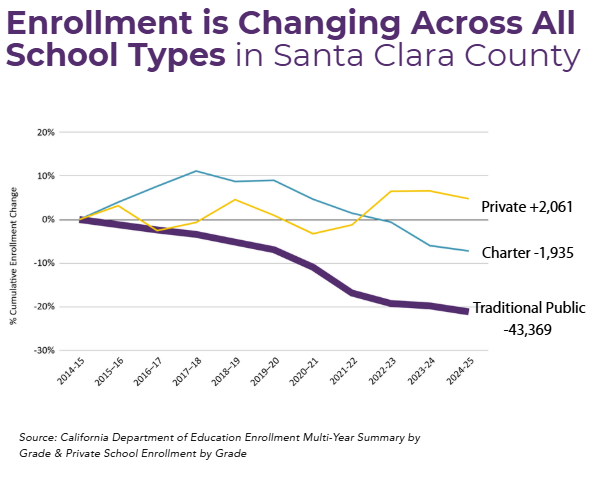
The chart at right shows that school districts in Santa Clara County have been losing students for years, even before the pandemic, in both traditional public elementary schools and charter schools.
In September 2025, SV@Home shared insights from research on the impacts of declining school enrollment in Santa Clara County, and the connection between school closures and our housing crisis. More housing that is accessible and affordable for young families is critical for the wellbeing of both children and schools. Safe, stable, healthy, and affordable housing sets kids up for learning, and allows schools to be able to focus on what they do best. Strong, supported schools with the resources they need can be anchors for communities during the school day and outside of it.
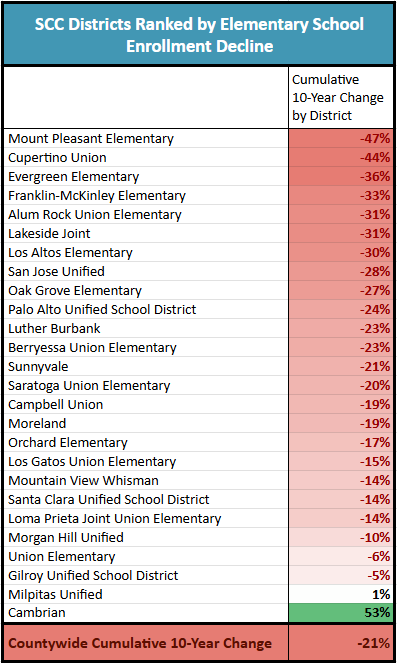
How is your school district doing?
Trends in elementary school enrollment are important to understanding not only today’s school conditions, but also the future of Silicon Valley’s high schools, universities, and future economic strength and resilience. Click to view detailed elementary enrollment trends for the county & district.
Education Workforce Housing
The high cost of housing is also impacting the stability of our education workforce: attracting new teachers and staff has grown increasingly challenging as housing prices have skyrocketed. Educators and school personnel cannot afford to live in the communities where they work, forcing them to commute long distances, experience housing instability, or to leave the education system altogether.
These conditions negatively affect both staff well-being and students’ learning environments. Stable, affordable housing is a foundational support that enables educators to remain rooted in the community and provide the continuity, trust, and long-term relationships that students need.
Affordable housing, including housing for the education workforce, helps create strong, supported schools with the resources they need to be anchors for communities.
The California School Boards Association, recognizing that housing affordability is one of the main barriers to attracting and retaining great teachers and staff across California, has developed extensive research, resources, and best practices to support districts exploring the development of education workforce housing on district land.
In most cities, existing policies are not producing enough affordable housing to meet the city’s goals or the community’s needs. Together cities, school districts, and community partners can help change that.
What Cities Can Do
- Create a dedicated local funding source for affordable housing
- Ensure a robust amount of land zoned for multifamily housing in places that support struggling schools
- Create regulations that promote and streamline the development of affordable housing, especially homes with 2 or more bedrooms
- Zone school land for a range of community-serving needs so school districts can use closed sites to continue to advance their missions
- In close partnership with school districts, provide technical assistance, funding, and support for community-serving development on school land
What School Districts Can Do
- Partner with local organizations to educate school communities about the role of affordable housing to support school health
- Survey local community stakeholders to understand needs that could be met at closed or underutilized school sites to support school and community health
- Partner with city governments and community partners to advance plans for affordable housing
- Join the growing number of peers leveraging underutilized land to develop workforce housing for teachers and school staff
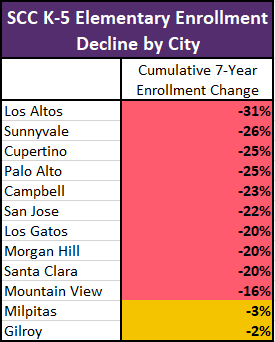
What’s happening with school enrollment in your city?
Click to view detailed elementary enrollment trends for the county & city.
- Campbell
- Cupertino
- Gilroy
- Los Altos
- Los Gatos
- Milpitas
- Morgan Hill
- Mountain View
- Palo Alto
- San Jose
- Santa Clara
- Sunnyvale
- Menlo Park
A powerful discussion on the housing-schools connection
A 2022 report commissioned by Silicon Valley Community Foundation, with community partners Palo Alto Forward and Silicon Valley at Home, uncovered an important finding about the relationship between new housing, school district stability, and financial security. New housing can help many districts with declining enrollment – avoiding revenue losses and associated staffing cutbacks and facility closures.
View The Missing Piece: How New Homes Can Help Save Our Schools from Declining Enrollment (2022), a conversation with Peter Ortiz, then President of the Santa Clara County Board of Education, Jennifer DiBrienza, then Vice President of the Palo Alto Unified School District Board, Steve Levy, Director and Senior Economist of the Center for the Continuing Study of the California Economy, and Kenneth Rosales, then Planning Senior Associate at SV@Home.